


 February 6, 2025
Transforming and Strengthening Bridges Using Ultra-High Performance Concrete

Aging infrastructure presents a significant maintenance and rehabilitation challenge for transportation agencies worldwide. Traditional bridge rehabilitation methods often struggle to withstand the test of time, leading to frequent maintenance and increased costs. Enter ultra-high performance concrete (UHPC) — a game-changing material that can improve bridge overlay durability.
Discover key insights and best practices from our recent pilot program with the District Department of Transportation (DDOT), which tested UHPC overlays across multiple bridges in Washington, D.C.
What is Ultra-High-Performance Concrete?
UHPC is a type of concrete material with exceptional compressive and tensile strength and durability. Unlike conventional concrete, which typically has a compressive strength of around 4,500 psi, UHPC strengths exceed 21,000 psi. Additionally, it contains steel fiber reinforcement, which minimizes cracking, improves structural integrity, and extends the life span of bridge decks.
This innovative concrete material offers significant advantages for bridge construction, including:
- Resistance to cracking and spalling.
- Reduced susceptibility to corrosion.
- Enhanced structural performance, even in high-traffic conditions.
- Extended service life with lower long-term maintenance costs.
The Unique Process of Applying UHPC Overlays
UHPC differs significantly from traditional concrete due to its specialized properties and application requirements. Unlike standard concrete, which is often pre-mixed and transported to the site, UHPC must be batched on-site to ensure its unique mix remains viable for placement. The material is delivered to the bridge deck via motorized buggies, a method designed to maintain workability and allow precise control during the overlay process.
The application process begins with hydrodemolition, a high-pressure water technique to remove damaged or deteriorated concrete and prepare the surface for the UHPC overlay. This step is critical to promote proper bonding between the existing bridge deck and the overlay, ultimately contributing to the structure’s longevity and durability.
One distinctive feature of UHPC overlays is the requirement for a quarter-inch overpour. This intentional excess accounts for the material’s high steel fiber content and provides a uniform surface. Once the material cures, the overpour is ground down to achieve the desired grade and texture. This grinding process serves multiple purposes; it creates grooves for improved traction, smooths out any exposed steel fibers to prevent issues like tire punctures, and enhances the overlay’s overall finish.
The grinding step is essential for mitigating the visual and functional effects of any irregularities in the poured material, delivering a consistent and durable surface. The meticulous attention to these details highlights why UHPC is a preferred choice for demanding applications, despite its higher upfront costs.
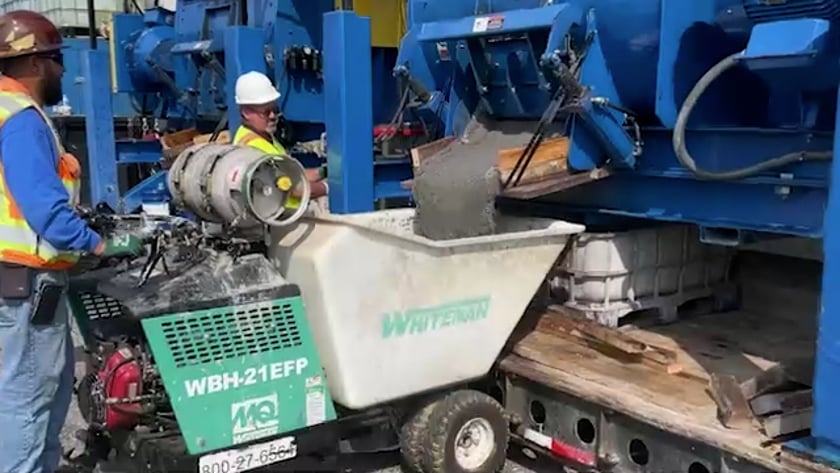
The pilot program created a mock-up site, where the concrete mix was batched on-site and delivered via motorized buggies.
The DDOT UHPC Pilot Program
Initiated by DDOT, the pilot program explored UHPC overlays to address crack mitigation in bridge deck surfaces over traditional repair methods. DDOT identified five bridges in relatively good condition with deck ratings of six or seven based on National Bridge Inspection Standards. The goal was to evaluate UHPC’s performance in real-world conditions and assess its cost-effectiveness compared to conventional building materials like latex-modified concrete mixtures. The pilot program bridges included:
- Southern Avenue over Suitland Parkway.
- 35th Street SE over East Capitol.
- Scale Gate Road NE over North Capitol Street.
- Park Place.
- 11th Street Bridge over I-295.
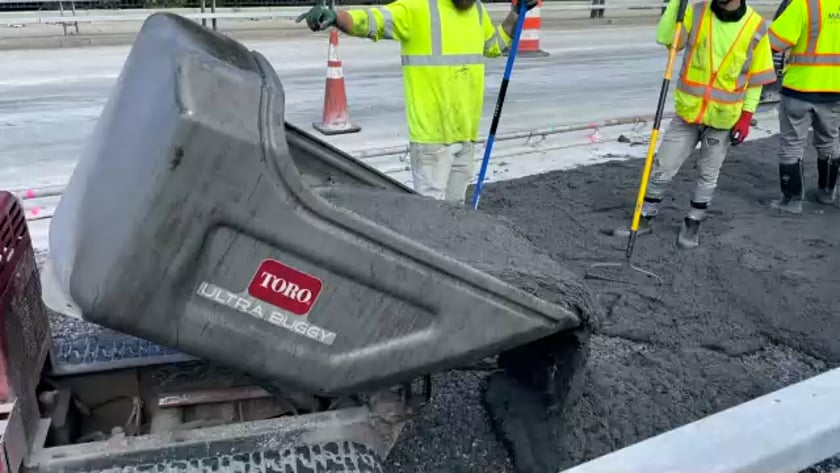
A crew applies UHPC on the Southern Avenue Bridge over the Suitland Parkway in Washington, D.C.
Lessons Learned from the Pilot Program
- Material Workability and Strength: UHPC is far more rigid than traditional concrete, making immediate placement and finishing critical. The material’s compressive strength results were remarkable, consistently exceeding 21,000 psi within 28 days. This strength translated into a durable overlay with minimal cracking, even under heavy traffic.
- Overpouring and Grinding: The hardened UHPC overpour requires specialized equipment because the material becomes extremely hard within days. Delays in this step resulted in excessive wear on grinding tools, underscoring the importance of timing.
- Cost Considerations: UHPC overlays cost more than traditional overlays. However, the anticipated reduction in long-term maintenance costs suggests that UHPC may prove more cost-effective over a bridge’s lifecycle.
- Material Durability: The steel fibers in UHPC enhance its durability. Preliminary results after one winter season, or one thawing cycle, showed no significant issues, and the material’s impermeability is expected to prevent long-term degradation from road salts and other environmental factors.
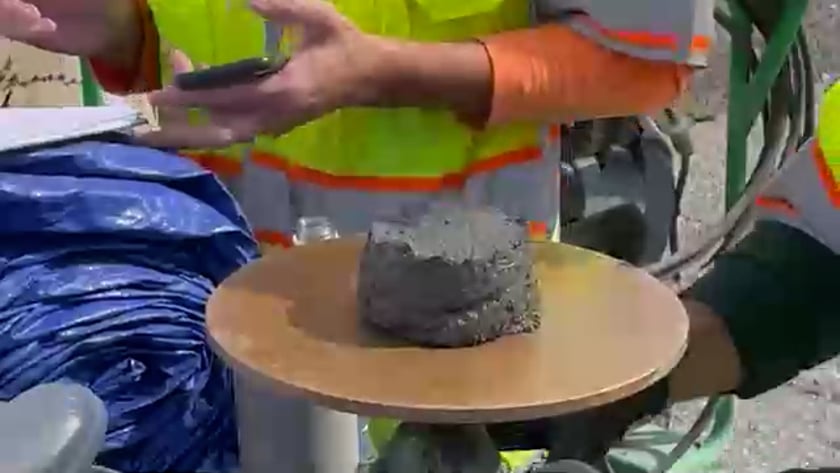
The team prepares a slump test, highlighting the toughness of the UHPC versus traditional concrete.
Looking Ahead
The pilot program demonstrated that UHPC has the potential to significantly extend the service life of bridge decks while reducing maintenance demands. Initial feedback from DDOT is overwhelmingly positive, with no significant cracking observed in the first year following installation. Additionally, biannual inspections and compressive strength tests confirm the material’s high-quality performance. Agencies like DDOT are now exploring broader applications of UHPC overlays, focusing on cost reduction as the material gains wider adoption.
Final Thoughts
UHPC represents a promising solution for aging infrastructure. While its upfront costs may be higher, the long-term benefits in terms of durability, reduced maintenance, and extended service life are compelling. The DDOT pilot program highlights the importance of careful planning, including proper specifications, experienced contractors, and timely execution, to maximize the material’s potential.
As the use of UHPC continues to grow, its transformative impact on bridge maintenance can help transportation agencies provide safe, reliable, and cost-effective transportation infrastructure for decades to come.
Meet our expert
Andrew Li, PE, PMP, CCM
Vice President, MidAtlantic Regional Business Line Manager, National Construction Services Business Growth and Sales Leader

Andrew Li, PE, delivers innovative, sustainable, technology-driven solutions for complex infrastructure projects. With expertise in project management, design, construction management/inspection, and client engagement, he’s known for blending technical precision with strategy.
Andrew Li, PE, PMP, CCM
Vice President, MidAtlantic Regional Business Line Manager, National Construction Services Business Growth and Sales Leader
Andrew Li, PE, delivers innovative, sustainable, technology-driven solutions for complex infrastructure projects. With expertise in project management, design, construction management/inspection, and client engagement, he’s known for blending technical precision with strategy.
Featured News & INSIGHTS
Replacing a Chicago Rail Bridge While Maintaining Continuous Service

Beyond the Control Room: How Traffic Operations are Shaping Transportation Systems in Real Time

Engineering Ingenuity: Replacing Bridge A32 and Grayland Station in Urban Chicago

From Roadway to Rail Trail: Adaptive Reuse of the Mount Carbon Bowstring Truss

In the News: GFT’s Interstate 5 Reconstruction Project Featured in Roads & Bridges Magazine

GFT Helps Lead the Conversation at IBC 2026

John Bergman, PE

Brian Seip, PE, CxA, LEED AP BD+C, CEA, REP, NCTI, ENV SP

