


 Sunbury, PA
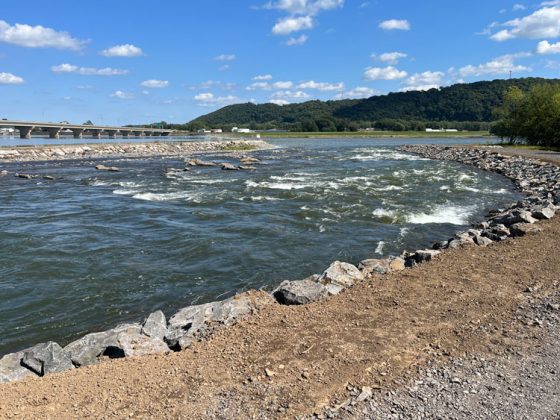
Fish Passage Design at the Adam T. Bower Memorial Dam
Client: Pennsylvania Department of General Services, Department of Conservation and Natural Resources
Our Role: Planning, Survey, and Design Services
Approximately two miles downstream of the Susquehanna River’s west and north branch confluence lies the Adam T. Bower Memorial Dam. Spanning the river’s width between the towns of Shamokin Dam and Sunbury, the dam is over 2,700 feet long and includes more than 2,000 feet of inflatable bags, making it the longest inflatable dam in the world.
When fully inflated for the May through October recreational season, the dam forms the 3,000-acre Lake Augusta, which is up to 10 feet deep and extends upstream for approximately 6.5 miles along both river branches. Lake Augusta is the focal point of the Shikellamy State Park and has provided anglers, boaters, water-skiers, and other day-trippers open-water recreational opportunities since the dam’s construction in 1970.
Industrial development throughout the 1900s restricted migratory fishes’ movement into the river’s headwaters, resulting in declining anadromous fish and catadromous eel populations. So, as a condition of the dam’s original permit, fish passage was required once other downstream dams on the river, including four hydropower dams, had fish passage facilities in place.
Once the downstream fish passages were added, American shad were observed near the base of the inflatable dam, demonstrating downstream migratory fish passage. This triggered the Pennsylvania Department of Conservation and Natural Resources (DCNR), the owner and operator of the Shikellamy State Park and the inflatable dam, to provide fish passage to satisfy the permit conditions and continue restoring the migration passage routes of the Susquehanna River.
With a drainage area of over 18,000 square miles, the inflatable dam and surrounding features create fish passage challenges. Operating the dam changes the seasonal headpond elevation by more than eight feet. Raising and lowering the dam during high water events creates unique hydraulic conditions that must be accounted for to provide ideal conditions for attracting and passing aquatic species through the fishway.
Limited space and the proximity of a U.S. Army Corps of Engineers levee system on the east riverbank also provided challenges. The fishway needed to be sited so that it would not adversely impact the levee system or the dam’s performance. It also could not increase upstream water elevations or adversely impact flooding. Creating a fishway that minimized maintenance activities was also critical to DCNR to not overtax the park staff’s limited resources.
In partnership with Kleinschmidt Associates, GFT provided the fishway’s preliminary and final design and construction-phase services.
We conducted topographic and bathymetric surveys to establish base mapping and horizontal and vertical controls. The project team performed fishway layout and hydraulic modeling, established staging area and erosion control measures, and developed a conceptual water diversion plan and construction cost estimates. Our detailed wetlands and waterway investigations and threatened and endangered species coordination supported DCNR’s permit applications.
Coordination with DCNR assisted in understanding the operating procedures associated with the inflatable dam. The project team reviewed historic river flows and established sound design criteria by holding design workshops with key stakeholders, including the U.S. Fish and Wildlife Service and the Pennsylvania Fish and Boat Commission, and developed a two-dimensional hydraulic model to analyze and support conceptual designs and cost estimates.
Key Features
- The fishway channel, floodplain, and strategically placed boulders produce varying flow conditions, allowing a wide range of aquatic species to pass through the fishway.
- Natural materials, like rock and boulders, minimize manufactured materials and better mimic the natural environment.
- The fishway’s rocky substrate resembles a natural streambed and creates a permanent riverine habitat while the fishway is in operation.
Outcomes
- Makes complex scientific concepts accessible to diverse audiences.
- Remediates the inflatable dam’s ecological impact on migratory fish by allowing aquatic species to pass the dam and continue to their historic spawning grounds in the headwaters of the Susquehanna River, contributing to migratory fish restoration.
- Facilitates recreation opportunities in Shikellamy State Park, attracting tourists and boosting the local economy.
- Provides quality aquatic habitat for macroinvertebrates and wading birds and provides upstream and downstream movement of resident and migrating species.


Featured Projects


Herring Run Trail Emergency Bank and Stream Restoration

Sligo Park Hills Low-Impact Development Stormwater Management Design


Peer Review and Safety Assurance Review for US Army Corps of Engineers

Hydropower and Power Distribution Facilities Security Risk Assessment

Region of Peel Airport Road Widening

Hopewell Water Treatment Plant Industrial Pump Station and Chemical/UV Facility

Wildlife Refuge Dam Decommissioning and Sediment Management
Fish Passage Design at the Adam T. Bower Memorial Dam

Baxter Water Treatment Plant Raw Water Basin Dredging


Hawaiian Dam Safety Seismic Hazard Assessment


Featured News & INSIGHTS
Harnessing the Power of Renewable Energy: Hydropower

Why Use Numerical Modeling to Make Dam Safety Risk Management Decisions?

Navigating Unstable Ground: Addressing Mine Subsidence and Karst Terrain

So Many Dam Problems, So Many Dam Possibilities: Navigating Change Through Design & Analysis

Nick Contreras Receives USSD’s Exceptional Young Professional Award

In the News: Kriebel Recognized by ASCE for Harbor and Coastal Engineering Achievements

Rob Scrafford, PE, PMP, F.SAME, ENV SP

Drew Kennedy, PG, CEG


